









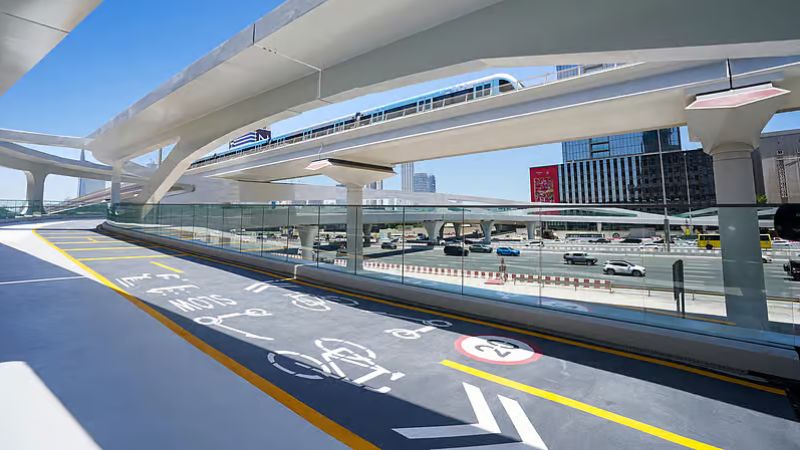
Dubai’s Roads and Transport Authority has approved the Soft Mobility Plan 2030. RTA
Residents of Al Rigga and Al Muraqqabat can expect safer and more convenient ways to move around their neighbourhoods as Dubai expands its network of walking, cycling and e-scooter infrastructure under a new five-year mobility programme.
The Roads and Transport Authority (RTA) has approved the Soft Mobility Plan 2030, which will improve infrastructure across 25 residential communities and around 63 public transport stations, making it easier for residents and visitors to complete first- and last-mile journeys between homes, workplaces and public transport.
Al Rigga and Al Muraqqabat are among the first areas where soft mobility improvements are already underway, alongside Dubai Marina, Al Murar and Naif.
The initiative forms part of Dubai’s broader vision to encourage sustainable transport while making neighbourhoods more pedestrian-friendly.
Mattar Al Tayer, Director General and Chairman of the Board of Executive Directors of the RTA, said soft mobility has become an important part of the city’s future transport strategy. “Soft mobility has become one of the strategic enablers of the future mobility ecosystem and a key pillar in strengthening integration across transport modes,” Al Tayer said. “It reinforces public transport’s position as the preferred mobility choice and supports Dubai’s sustainability and quality-of-life objectives, in line with the Dubai 2040 Urban Master Plan.”
The upgrades will include new cycling tracks, dedicated walking paths, raised pedestrian crossings, traffic-calming measures, bicycle parking, shared-use lanes, shaded walkways, landscaped rest areas, passenger pick-up and drop-off points, and facilities for People of Determination.
The improvements are designed to provide seamless connections between residential communities and Metro and bus stations while encouraging residents to choose healthier and more environmentally friendly modes of transport.
The RTA said pedestrian activity in Dubai continues to rise, with walking trips increasing from 326 million in 2024 to 342 million in 2025, representing a five percent increase. Cycling has also grown in popularity, with trips climbing from 46.6 million to 57.3 million over the same period, while e-scooter journeys rose from 32.3 million to 39.6 million, both recording growth of nearly 23 percent.
By 2030, the plan will expand soft mobility infrastructure to a total of 34 residential areas, while improving access around 63 public transport stations across the emirate.
The RTA has already completed similar projects in Abu Hail, Al Barsha 1, Al Barsha 2, Al Karama, Al Khawaneej 2, Al Mankhool, Al Qusais, Al Souk Al Kabeer and Hor Al Anz, as well as around 37 Metro stations including BurJuman, Burj Khalifa/Dubai Mall, Gold Souq, Mall of the Emirates, ONPASSIVE, Sharaf DG, Baniyas Square and Abu Hail.
According to the RTA, the programme supports Dubai’s transition towards a fully integrated transport network where walking, cycling, e-scooters and public transport work together to deliver safer, more sustainable and more connected journeys across the emirate. ICA/Expat Media
For all the latest news from the UAE and the world, follow us on Facebook, Twitter and Instagram and subscribe to our YouTube page







+ There are no comments
Add yours